What were the rules that residents had to follow while staying at Hull House?
| Hull House | |
| U.South. National Register of Historic Places | |
| U.Due south. National Historic Landmark | |
| Chicago Landmark | |
 Hull House in the early on 20th century | |
| | |
| Location | 800 Due south. Halsted, Chicago, Illinois |
|---|---|
| Coordinates | 41°52′xviii″N 87°38′51″W / 41.87167°N 87.64750°W / 41.87167; -87.64750 Coordinates: 41°52′18″N 87°38′51″West / 41.87167°Due north 87.64750°Due west / 41.87167; -87.64750 |
| Surface area | 1 acre (0.40 ha) |
| Congenital | building built in 1856, institution founded September eighteen, 1889 |
| Architect | Swimming and Pond |
| Architectural style | Italianate[ane] |
| NRHP referenceNo. | 66000315[1] |
| Significant dates | |
| Added to NRHP | October 15, 1966[one] |
| Designated NHL | June 23, 1965[2] |
| Designated CL | June 12, 1974 |


Hull Firm was a settlement firm in Chicago, Illinois, United states that was co-founded in 1889 past Jane Addams and Ellen Gates Starr. Located on the Nigh West Side of the city, Hull House (named afterward the original business firm'southward first owner Charles Jerald Hull) opened to serve recently arrived European immigrants. By 1911, Hull House had expanded to 13 buildings. In 1912 the Hull Firm complex was completed with the add-on of a summertime campsite, the Bowen Country Gild.[3] [iv] [5] With its innovative social, educational, and creative programs, Hull House became the standard bearer for the motion that had grown nationally, by 1920, to most 500 settlement houses.[6]
The Hull mansion and several subsequent acquisitions were continuously renovated to accommodate the changing demands of the association. In the mid-1960s, about of the Hull Firm buildings were demolished for the construction of the University of Illinois-Chicago. The original building and one boosted edifice (which has been moved 200 yards (182.nine m))[seven] survive today. On June 23, 1965, information technology was designated as a U.Southward. National Historic Landmark.[eight] On October 15, 1966, the twenty-four hour period that the National Historic Preservation Act of 1966 was enacted, it was listed on the National Register of Celebrated Places. On June 12, 1974, the surviving Hull mansion was designated as a Chicago Landmark.[nine]
Hull mansion was one of the starting time 4 structures to exist listed on both the Chicago Registered Historic Places and the National Register of Historic Places list (forth with Chicago Pile-1, Robie House & Lorado Taft Midway Studios).[1] Afterwards The Hull Business firm Association moved from the original buildings complex in the 1960s, it continued to provide social services in multiple locations throughout Chicago. Information technology finally ceased operations in January 2012. The Hull mansion and a related dining hall, the but remaining survivors on the Hull House circuitous, are now maintained every bit a history museum.
Mission [edit]
Addams followed the example of Toynbee Hall, which was founded in 1884 in the Due east End of London every bit a center for social reform. She described Toynbee Hall as "a community of university men" who, while living there, held their recreational clubs and social gatherings at the settlement business firm amidst the poor people and in the same style they would in their own circle.[10] Addams and Starr established Hull House as a settlement business firm on September 18, 1889.[11]
In the 19th century a women's movement began to promote education and autonomy, and to break into traditionally male-dominated occupations for women. Organizations led by women, bonded past sisterhood, were formed for social reform, including settlement houses such equally Hull House, situated in working class and poor neighborhoods. To develop "new roles for women, the first generation of New Women wove the traditional ways of their mothers into the heart of their brave new earth. The social activists, often single, were led past educated New Women.[12]
Hull House became, at its inception in 1889, "a community of university women" whose main purpose was to provide social and educational opportunities for working class people (many of them recent European immigrants) in the surrounding neighborhood. The "residents" (volunteers at Hull were given this title) held classes in literature, history, fine art, domestic activities (such every bit sewing), and many other subjects. Hull House also held concerts that were free to everyone, offered free lectures on current issues, and operated clubs for both children and adults.
In 1892, Addams published her thoughts on what has been described as "the three R's" of the settlement house motility: residence, inquiry, and reform. These involved "close cooperation with the neighborhood people, scientific study of the causes of poverty and dependence, communication of these facts to the public, and persistent pressure for [legislative and social] reform..."[13] Hull House conducted conscientious studies of the Near Westward Side, Chicago community, which became known as "The Hull Business firm Neighborhood". These studies enabled the Hull House residents to face up the establishment, eventually partnering with them in the blueprint and implementation of programs intended to enhance and improve the opportunities for success by the largely immigrant population.[14]
According to Christie and Gauvreau (2001), while the Christian settlement houses sought to Christianize, Jane Addams, "had come up to epitomize the force of secular humanism." Her image was, withal, "reinvented" by the Christian churches.[15] According to the Jane Addams Hull-Business firm Museum, "Some social settlements were linked to religious institutions. Others, like Hull-House [co-founded by Addams], were secular."[16]
Hull Firm neighborhood [edit]
I of the first paper manufactures ever written Hull House[17] quotes the following invitation sent to the residents of the Hull House neighborhood. It begins with: "Mio Carissimo Amico"...and is signed, Le Signorine, Jane Addams and Ellen Starr. That invitation to the customs, written during the first year of Hull House'due south existence, suggests that the inner core of what Addams labeled "The Hull Business firm Neighborhood" was overwhelmingly Italian at that time. "x,000 Italians lived between the river and Halsted Street."[eighteen]

Hull House customs workshop poster, 1938
Past all accounts, the greater Hull House neighborhood (Chicago's Near Due west Side) was a mix of various ethnic groups that had immigrated to Chicago. At that place was no discrimination of race, linguistic communication, creed, or tradition for those who entered the doors of the Hull House. Every person was treated with respect. The Bethlehem-Howard Neighborhood Heart records substantiate that, "Germans and Jews resided south of that inner core (s of 12th street)…The Greek delta formed by Harrison, Halsted and Blueish Isle Streets served every bit a buffer to the Irish residing to the south and the Canadian–French to the northwest. From the river on the due east cease, on out to the western ends of what came to be known equally "Little Italia", from Roosevelt Road on the s to the Harrison Street delta on the n, became the port-of-call for Italians who continued to immigrate to Chicago from the shores of southern Italy until a quota system was implemented in 1924 for about Southern Europeans.[4]
The Greektown and Maxwell Street residents, along with the remnants of other immigrant groups living on the outer fringes of the Hull House Neighborhood, disappeared long before the physical demise of Hull Business firm. The exodus of most ethnic groups began presently after the turn of the twentieth century. Their businesses, eastward.g. Greektown and Maxwell Street, however, remained. Italian Americans were the only immigrant group that endured every bit a vibrant on-going customs. That community came to be known as "Lilliputian Italia". Taylor Street's Piddling Italia, the inner core of Addams' "Hull Firm Neighborhood", remained equally the laboratory upon which the social and philanthropic groups of Hull House elitists had tested their theories and formulated their challenges to the establishment.[three]
The synergy betwixt Taylor Street's Fiddling Italy and the Hull Business firm complex; i.e., the settlement firm and its summer military camp, the Bowen State Club, is well documented.[3] Dr. Alice Hamilton, an early on fellow member of that aristocracy Hull House bureaucracy, wrote in her autobiography, "Those Italian women knew what a baby needed, far better than my Ann Arbor professors did."[19] The ancillary literature between, among and about members of Hull Business firm's inner sanctum of sociologists and philanthropists is littered with such comments, reinforcing the relationship that existed between Taylor Street's Piddling Italia and Hull Business firm. A review of the ethnic composition of those who registered for and utilized the services provided by the Hull House complex, during its 74 years as a tenant of the about-west side, suggests an ethnic bias. Of the 257 known WWII veterans who were alumni of the Bowen Country Club, "almost all had a vowel at the end of their names...cogent their Italian heritage."[iii]
A historic picture show, "Meet the Hull House Kids," was taken on a summer day in 1924 by Wallace Chiliad. Kirkland Sr., Hull Business firm Director. He later became a pinnacle photographer with Life. The twenty Hull House Kids were erroneously described equally young boys, of Irish gaelic ancestry, posing in the Dante Schoolhouse yard on Forquer Street (now Arthington Street). Information technology circulated the world as a "poster kid" of sorts for the Hull House social experiment. On April 5, 1987, over a half century later, the Chicago Lord's day-Times refuted the contention that the Hull House Boys were of Irish beginnings. In doing and then, the Sunday-Times article listed the names of each of the young boys.[twenty] All twenty boys were first-generation Italian-Americans, all with vowels at the end of their names. "They grew upwards to be lawyers and mechanics, sewer workers and dump truck drivers, a candy store owner, a boxer and a mob dominate."
Because of the immigrants' loneliness for their homeland, Addams started hosting indigenous evenings at Hull House. This would include indigenous food, dancing, music, and mayhap a short lecture on a topic of interest. Some of the themed evenings were Italian, Greek, German language, Polish, etc. Ellen Gates Starr described one Italian evening as having the room packed full with people. One of the ladies who attended "recited a patriotic poem with great spirit" and everyone was moved by it.[21]
Accomplishments [edit]
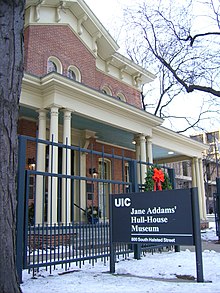
Jane Addams Hull-House Museum in 2006. The museum is located in and preserves the first building from which the Addams settlement took its name, Hull Firm, and one related structure. Additional settlement facilities. which over-time grew upwardly effectually the house, were removed in the 1960s.
Throughout the showtime two decades, forth with thousands of immigrants from the surrounding area, Hull Firm attracted many female person residents who later became prominent and influential reformers at various levels.[6] At the starting time, Addams and Starr volunteered as on-call doctors when the real doctors either didn't show upward or weren't available. They acted as midwives, saved babies from neglect, prepared the dead for burial, nursed the sick, and sheltered domestic violence victims. For case, one Italian helpmate had lost her wedding band and in turn was beaten by her husband for a week. She sought shelter at the settlement and information technology was granted to her. Also, a baby born with a cleft palate was unwanted past his mother then he was kept at the Hull Firm for six weeks after an operation. In another case, a adult female was about to requite nascence to an illegitimate baby, and so none of the Irish matrons would touch it. Addams and Starr stepped in and delivered this helpless niggling one. Finally, a female Italian immigrant was so thrilled near fresh roses at ane of the Hull House receptions that she insisted they had come from Italy. She had never seen anything every bit beautiful in America despite the fact that she lived within x blocks of a florist shop. Her limited view of America came from the untidy street she lived on and the long struggle to adjust to American means.[22] The settlement was as well gradually fatigued into advocating for legislative reforms at the municipal, state and federal levels, addressing issues such as kid labor, women's suffrage, healthcare reform and clearing policy. Some claim that the work of the Hull House marked the beginning of what we know today as "Social Welfare".[23]
At the neighborhood level, Hull House established the city's get-go public playground, bathhouse, and public gymnasium (in 1893), pursued educational and political reform, and investigated housing, working, and sanitation issues.[half-dozen] The playground opened on May Day in 1893, located on Polk Street. Families dressed in party attire and came to bring together the celebration that day. Addams had studied kid behavior and painfully concluded that "children robbed of childhood were likely to become dull, sullen men and women working mindless jobs, or criminals for whom the run a risk of crime became the only way to break out of the bleakness of their lives" [24] Addams' thinking regarding the importance of childhood play opportunities contributed to a national conversation about the need for playgrounds and a movement that started the Playground Association of America [25] Also, one volunteer, Jenny Dow, started a kindergarten class for children left at the settlement while their mothers worked in the sweatshops. Within three weeks, Dow had 24 registered kindergartners and 70 on a waiting list.[26] At the municipal level, their pursuit of legal reforms led to the first juvenile court in the United States, and their work influenced urban planning and the transition to a branch library system.[half dozen] At the state level Hull House influenced legislation on kid labor laws, occupational safe and health provisions, compulsory education, immigrant rights, and alimony laws.[6] These experiences translated to success at the federal level, working with the settlement house network to champion national child labor laws, women's suffrage, a children'south bureau, unemployment compensation, workers' compensation, and other elements of the Progressive agenda during the first two decades of the twentieth century.[6]
Teachings [edit]


Women's Society building, 1905

Children in line on a retaining wall at Hull House, 1908
Later, the settlement branched out and offered services to better some of the effects of poverty. A public dispensary provided nutritious food for the sick too every bit a daycare center and public baths. Amidst the courses Hull House offered was a bookbinding course, which was timely — given the employment opportunities in the growing printing trade.[27] Hull House was well known for its success in aiding American assimilation, especially with immigrant youth.[28] Hull House became the center of the movement to promote hand workmanship equally a moral regenerative strength.[29] Under the direction of Laura Dainty Pelham their theater group performed the Chicago premiers of several plays past John Galsworthy, Henrik Ibsen, and George Bernard Shaw, and was given credit for founding the American Little Theatre Movement.[30] The success of Hull House led Paul Kellogg to refer to the group as the "Groovy Ladies of Halsted Street".[31]
The objective of Hull House, equally stated in its lease, was: "To provide a middle for a higher civic and social life; to plant and maintain educational and philanthropic enterprises, and to investigate and better the conditions in the industrial districts of Chicago."[32]
The building and museum [edit]

Starr, 1914

Addams, 1915
Hull House was located in Chicago, Illinois, and took its proper noun from the Italianate mansion built by real estate magnate Charles Jerald Hull (1820–1889) at 800 Southward Halsted Street in 1856. The building was located in what had once been a stylish part of town, simply past 1889, when Addams was searching for a location for her experiment, it had descended into squalor. This was partly due to the rapid and overwhelming influx of immigrants into the Nigh Due west Side neighborhood. Charles Hull granted his onetime habitation to his niece Helen Culver, who in turn granted it to Addams on a 25-twelvemonth hire-free charter. By 1907, Addams had acquired 13 buildings surrounding Hull's mansion. Between 1889 and 1935, Addams and Ellen Gates Starr continuously redeveloped the building.[7] In 1912, the Bowen Country Club summer campsite was added to complete the Hull House complex.[ citation needed ] The facility remained at the original location until it was purchased in 1963 by what was then chosen the University of Illinois-Circle Campus.[33] The development of University of Illinois-Circle Campus required the demolition of most of the Hull House buildings[7] and the 1967 restoration to the original building by Frazier, Raftery, Orr and Fairbank removed Addams'due south third floor improver. In addition to the mansion, of the dozen additional buildings just the craftsman style dining hall (built in 1905 and designed by Pond & Pond) survives and it was moved 200 yards (182.9 m) from its original site to exist adjacent to the mansion.[7] [34]
The haunting of Hull House [edit]
Addams noted upon moving in that the building had a "half skeptical reputation for a haunted cranium."[35] Over the years, numerous stories of ghosts and hauntings take surrounded Hull House, making it a stop on many of the "ghosts in Chicago" tours. Charles Hull's wife had died in the firm in 1860, and is sometimes thought to haunt it.[36] Other candidates for resident ghosts include the many people who died there of natural causes in the 1870s when information technology was used every bit a home for the aged by the Petty Sisters of the Poor.[36]
In 1913, another Hull House ghost story began circulating. According to this fable, after a man claimed that he would rather have the Devil in his house than a flick of The Virgin Mary, his child was born with pointed ears, horns, scale-covered pare, and a tail. The mother was said to have taken the infant to Hull Business firm, where Addams was said to have attempted to have it baptized and wound upward locking it in the attic.[37] While initially annoyed about the story, which had no basis in fact, Addams became fascinated by the effect the episode had on old women in the neighborhood and used the episode as a basis for her volume The Long Route of Adult female'due south Memory.[38]
While a bully many erroneous stories have circulated about the edifice, Addams is known to have spoken to several friends about one of the front end bedrooms on the 2d floor existence haunted – she and a friend once thought they saw a "woman in white" ghost there, and the aforementioned ghost was later seen by a group of girls when the room was used as a dressing room for the adjacent theater. Though Addams called information technology "haunted," she seems to have been more than amused than frightened past information technology.[36]
Theater [edit]
Addams felt that the community benefits from theater plays and thus established an amateur theater in the Hull House in 1899.[39] "The neighborhood Greeks performed the classic plays of antiquity in their own linguistic communication and the children of European immigrants produced Shakespeare" as well as others.[40] Early one December, the Greeks performed Odysseus in Chicago. The auditorium was filled with a multi-indigenous crowd and packed too close for comfort. The audition was very eager and gave the performers "rapt attention."[41] They watched neighbors and co-workers execute this primitive play, but it was very powerful, plausible, and personal. The actors seemed to pay "tribute to a noble beginnings" and plea for the respect of the audition.[41] Indeed, they did gain this respect because it was said that non even trained college students could give the same play with as much zeal and patriotism.[41] Chicago'southward noted improvisational theatre scene has roots in Hull House, as Viola Spolin, noted improvisational techniques teacher, taught classes at Hull Firm.[42] In 1963, when road tours of Broadway productions became common, the Hull Firm Theater in the Jane Addams Center at 3212 N Broadway fostered the development of Chicago Theater companies for the rest of the century.[39] Founder Robert Sickinger created an environment to nourish young talent with professionalism.[43]
1930s to 2012 [edit]
Addams was head resident until her expiry in 1935. Hull House continued to serve the customs surrounding the Halsted location until information technology was displaced by the urban branch campus of the University of Illinois in the 1960s. Until 2012, the social service center role was performed throughout the city at diverse locations under an umbrella organization, the Jane Addams Hull House Association.[vi] The original Hull House edifice itself is a museum, function of the College of Compages and the Arts at the University of Illinois at Chicago, and is open to the public.
The Jane Addams Hull Business firm Clan was one of Chicago's largest nonprofit social welfare organizations. Its mission was to improve social atmospheric condition for underserved people and communities past providing creative, innovative programs and past advocating for related public policy reforms. The Association had more than l programs at over 40 sites throughout Chicago and served approximately 60,000 individuals, families, and customs members every year.[44]
The Jane Addams Hull-House Museum is part of the College of Compages and the Arts at the University of Illinois at Chicago and serves every bit a memorial to Addams and other resident social reformers, whose piece of work influenced the lives of their immigrant neighbors, likewise as national and international public policy. The museum and its programs connect the work of Hull Firm residents to of import contemporary social problems. The Museum's drove includes over i,100 artifacts related to Hull House history and over 100 oral interviews conducted with people who accept shared their stories near Hull House and the surrounding neighborhood.[45]
Hull Firm Association Closure [edit]
Because of its heavy reliance on public support—as much as 85 percent of its revenue came from such sources—had essentially become an arm of government, dissimilar anything Ms. Addams might recognize today.[46] When Clarence Wood, and then the head of Chicago's Homo Relations Commission, took over in 2000, he promised to motion toward more private fundraising. Just that effort appears to take failed to bring in more than than a few one thousand thousand dollars in any given year, accounting for less than 10 percent of the agency's funding in most of the concluding decade, according to fiscal statements filed with the IRS and the Illinois attorney general's office.[47]
On January 19, 2012, it was announced that Jane Addams Hull House Clan would close in the bound of 2012 and file for bankruptcy due to financial difficulties, later on almost 122 years.[48] On Friday, January 27, 2012, Hull Business firm closed unexpectedly and all employees received their terminal paychecks.[49] Employees learned at time of closing that they would not receive severance pay or earned vacation pay or healthcare coverage.[50] Union officials said that the agency closed while attributable employees more than $27,000 in unpaid expense reimbursement claims.[51] The University of Illinois at Chicago's Jane Addams Hull-Business firm Museum (unaffiliated with the agency), however, remains open.[52]
Selected notable residents [edit]
- Edith Abbott
- Grace Abbott
- Jane Addams
- Ethel Percy Andrus
- Enella Benedict
- Neva Boyd
- Sophonisba Breckinridge
- Charlotte East. Carr, caput resident 1937-1942
- Cornelia De Bey
- Dorothy Detzer
- Emily Edwards (de Cantabrana)
- Julia I. Felsenthal
- Pauline Gibling Schindler
- Charlotte Perkins Gilman
- Henry Standing Carry
- Alice Hamilton
- Florence Kelley
- Mary Kenney O'Sullivan
- Julia Lathrop
- Dorothy Loeb
- Robert Morss Lovett[53]
- Mary McDowell
- Ernest Carroll Moore, founder and first provost of UCLA
- Willard Motley
- Frances Perkins
- Adena Miller Rich, head resident 1935-1937
- Eleanor Clarke Slagle, founder of occupational therapy
- Viola Spolin
- Alzina Stevens
- Gerard Swope, General Electrical Company (1922–1939)[54]
- Victor Yarros and Rachelle Yarros
Selected notable alumni [edit]
- Benny Goodman[55]
See also [edit]
- Jane Addams Burying Site
- John H. Addams
- John H. Addams Homestead
- History of social work
- Hull House Music School
Notes [edit]
- ^ a b c d "National Register Information System". National Annals of Historic Places. National Park Service. January 23, 2007.
- ^ "Hull House". National Historic Landmark summary list. National Park Service. Archived from the original on Nov 14, 2007. Retrieved June 11, 2008.
- ^ a b c d "Home Page". Taylor Street Archives. Archived from the original on October 20, 2013. Retrieved January 5, 2021.
{{cite web}}: CS1 maint: unfit URL (link) - ^ a b Hull Firm Museum
- ^ Jane Addams, Twenty Years at Hull House
- ^ a b c d e f one thousand Johnson, Mary Ann (2004). "Hull House". In Grossman, James R.; Keating, Ann Durkin; Reiff, Janice L. (eds.). The Encyclopedia of Chicago. Chicago Historical Society.
- ^ a b c d Schulte, Franz and Kevin Harrington, Chicago's Famous Buildings, fifth edition, Academy of Chicago Press, 2004, pp. 212–3, ISBN 0-226-74066-8.
- ^ "Hull House". National Park Service. Archived from the original on November 14, 2007. Retrieved March 23, 2007.
- ^ "Jane Addams' Hull Firm". City of Chicago Department of Planning and Development, Landmarks Partition. 2003. Archived from the original on August iii, 2001. Retrieved March six, 2007.
- ^ Polikoff, Barbara Garland. With Ane Bold Act : The Story of Jane Addams, p. 55, New York: Boswell Books, 1999.
- ^ Johnson, Mary Ann. "Hull House". Electronic Encyclopedia of Chicago. Chicago Historical Club. Retrieved September 9, 2013.
- ^ Carroll Smith-Rosenberg. Disorderly Bear: Visions of Gender in Victorian America. Oxford University Press; 1986. ISBN 978-0-19-504039-five. p. 255.
- ^ Wade. Louise C. (Winter 1967). "The Heritage from Chicago's Early Settlement Houses". Journal of the Illinois State Historical Order. 60 (4): 411–441, 414. JSTOR 40190170.
- ^ "Hull-Firm Maps Its Neighborhood". The Electronic Encyclopedia of Chicago. Chicago Historical Club. 2005. Retrieved March 26, 2007.
- ^ Christie, C., Gauvreau, Thousand. (2001). A Full-Orbed Christianity: The Protestant Churches and Social Welfare in Canada, 1900–1940 McGill-Queen's Printing – MQUP, Jan xix, 2001 pg 107
- ^ "landing page". Jane Addams Hull-House Museum . Retrieved March 25, 2018.
- ^ Chicago Tribune, May xix, 1890.
- ^ Jane Addams, Images of Hull House, p. 10.
- ^ Hamilton, Alice (1943). Exploring the Dangerous Trades – The Autobiography of Alice Hamilton, M.D. Boston, MA: Little, Brown and Company. p. 69.
- ^ Michael Cordts, "Run across the 'Hull House Kids'", Chicago Sun-Times, Sun, Apr 5, 1987, page half-dozen.
- ^ Polikoff, Barbara Garland. With Ane Bold Human activity : The Story of Jane Addams, p. 76, New York: Boswell Books, 1999.
- ^ Addams, Jane, and Ruth W. Messinger. Xx Years at Hull-House, p. 72-73, New York: Signet Classics, 1999.
- ^ Jackson, Shannon. "Theorizing: 'The Scaffolding'." Lines of Activeness Performance, Historiography, Hull House Domesticity. Ann Arbor: the University of Michigan Press, 2001 as cited at http://louisville.edu/a-s/english/haymarket/stanton/bibpage.html on March 28, 2007.
- ^ Polikoff, Barbara Garland. With One Assuming Human activity : The Story of Jane Addams, p. 124-126, New York: Boswell Books, 1999.
- ^ "Playground Association of America: Early Days - Social Welfare History Project". vcu.edu. August 21, 2012. Retrieved March 25, 2018.
- ^ Polikoff, Barbara Garland. With One Bold Act : The Story of Jane Addams, p. 74, New York: Boswell Books, 1999.
- ^ Gehl, Paul F. (2004). "Book Arts". In Grossman, James R.; Keating, Ann Durkin; Reiff, Janice 50. (eds.). The Encyclopedia of Chicago. Chicago Historical Guild.
- ^ Gems, Gerald R. (2004). "Clubs: Youth Clubs". In Grossman, James R.; Keating, Ann Durkin; Reiff, Janice L. (eds.). The Encyclopedia of Chicago. Chicago Historical Society.
- ^ Darling, Sharon South. (2004). "Arts and Crafts Move". In Grossman, James R.; Keating, Ann Durkin; Reiff, Janice L. (eds.). The Encyclopedia of Chicago. Chicago Historical Society.
- ^ Peggy Glowacki and Julia Hendry, Images of America: Hull-House, Arcadia Publishing, Chicago, Illinois, 2004 p. 34, ISBN 0-7385-3351-3
- ^ McMillen, Wayne (2007). "SSA Bout: Edith Abbott". The University of Chicago School of Social Service Administration. Archived from the original on Dec xxx, 2006. Retrieved January 7, 2007.
- ^ All ACUA Staff (2007). "Hull House Settlement House Questionnaire, 1893". The Catholic University Of America. Archived from the original on November 30, 2006. Retrieved March 26, 2007.
- ^ "Jane Addams' Hull House". City of Chicago Department of Planning and Evolution, Landmarks Partition. 2003. Archived from the original on February three, 2007. Retrieved Jan 3, 2007.
- ^ Sinkevitch, Alice, AIA Guide To Chicago, second edition, A Harcourt Original, 2004, pp. 301–2, ISBN 0-15-222900-0.
- ^ J. Addams, Twenty Years at Hull Firm, (New York: MacMillan & Co., 1910), ch.5.
- ^ a b c "Ghosts of Hull Firm: Mysteries and Myths. New ebook and podcast!". The Chicago Unbelievable Blog. Retrieved March 11, 2011.
- ^ J. Addams, "The Long Route of Adult female's Memory," New York, MacMillan & Co., 1917, ch.1
- ^ Selzer, Adam (October 8, 2012). Your Neighborhood Gives Me the Creeps: True Tales of an Accidental Ghost Hunter. Llewellyn Worldwide. p. 86. ISBN978-0-7387-1557-5 . Retrieved January 24, 2019.
- ^ a b Christiansen, Richard (2004). "Theater Companies". In Grossman, James R.; Keating, Ann Durkin; Reiff, Janice Fifty. (eds.). The Encyclopedia of Chicago. Chicago Historical Gild.
- ^ Haldeman-Julius, Marcet. Jane Addams As I Knew Her (Grand Rapids: Kessinger, LLC, 1999 [1934]), p. iv.
- ^ a b c "Hull-House Retrospect", Hull-House Message IV, no. ane (1900), n.p. Urban Feel In Chicago: Hull-Firm and Its Neighborhoods. 25 Apr. 2006. University of Illinois at Chicago. Fall 2008 <http://www.uic.edu/jaddams/hull/urbanexp/contents.htm>.
- ^ Richard Sisson; Christian Grand. Zacher; Andrew Robert Lee Cayton (November eight, 2006). The American Midwest. ISBN0253003490.
- ^ Telli, Andrea; Richard Pettengill (2004). "Acting, Ensemble". In Grossman, James R.; Keating, Ann Durkin; Reiff, Janice L. (eds.). The Encyclopedia of Chicago. Chicago Historical Society.
- ^ "Who We Serve". Jane Addams Hull House Clan. Archived from the original on June 6, 2010. Retrieved June 3, 2020.
{{cite web}}: CS1 maint: unfit URL (link) - ^ "Jane Addams Hull Business firm Museum". University of Illinois at Chicago. Retrieved October 22, 2008.
- ^ Westward, Maureen (February ii, 2012). "What Would Founder Jane Addams Think of Hull House Demise?". The Chronicle of Philanthropy.
- ^ Ford, L., & Thayer, K. (2012, January 21). Reliance on shrinking government funds doomed Hull House: Longtime social service agency no longer able to balance its books. Chicago Tribune. http://articles.chicagotribune.com/2012-01-21/news/ct-met-hull-business firm-closes-20120121_1_hull-house-land-funding-jane-addams
- ^ Thayer, Kate (January 19, 2012). "Jane Addams Hull House to close". Chicago Tribune . Retrieved January xx, 2012.
- ^ "Hull Business firm closes later on more than 120 years". Fort Wayne News-Sentinel. Jan 28, 2012. Archived from the original on January eleven, 2015. Retrieved Jan 29, 2012.
- ^ "Jane Addams Hull House closing doors". ABC News Chicago. January 27, 2012. Retrieved January 27, 2012.
- ^ "Hull House endmost Fri". Chicago Tribune. January 25, 2012. Retrieved January 25, 2012.
- ^ Webber, Tammy (January 27, 2012). "Hull House Closes Doors Subsequently More Than 120 Years". ABC News. Retrieved January 29, 2012.
- ^ Famous American Women: A Biographical Lexicon from Colonial Times to the Present
- ^ Mary Colina Swope Papers, University of Illinois Chicago – Richard J. Daley Library Special Collections and University Archives http://world wide web.uic.edu/depts/lib/specialcoll/services/rjd/findingaids/MSwopef.html .
- ^ "Biographies: Benny Goodman". JAZZ—A Film by Ken Burns. PBS. Archived from the original on December 28, 2012. Retrieved January 5, 2021.
{{cite web}}: CS1 maint: unfit URL (link)
External links [edit]
- In the Vicinity of Maxwell Halsted Streets 1890-1930
- Jane Addams Hull-House Museum
- Jane Addams Hull House Clan
- Twenty Years at Hull House online editions
- Hull House at Standard Ebooks
- Twenty Years at Hull House, past Jane Addams, MacMillan & Co, 1910, at Project Gutenberg
-
 Xx Years at Hull House public domain audiobook at LibriVox
- Eleanor Smith's Hull House Songs: The Music of Protest and Hope in Jane Addams's Chicago, past Cassano (Graham), Lunin Schultz (Rima) and Payette (Jessica), Leiden: Brill, 2019
- The Pots of Promise Exhibit
- Urban Experience In Chicago: Hull-House and Its Neighborhoods, 1889–1963
- Hull House Jubilee Article
- Taylor Street Athenaeum: UIC: Flawed History
- Bowen Country Club – digital images from the UIC Library collections
- Hull-Firm Yearbook – digital images from the UIC Library collections
- Closing of Hull Firm
- Staff Interview on Closing of Hull Firm
Source: https://en.wikipedia.org/wiki/Hull_House
0 Response to "What were the rules that residents had to follow while staying at Hull House?"
Post a Comment